Green Capacity--building human and intellectual capital for a biologically sustainable future.
It takes a team of dedicated individuals to work together to ensure the sustainability of our forests and biodiversity-that is our commitment to the next generation and to all living things.
Together we can make a difference.
Director and Founding Board Member
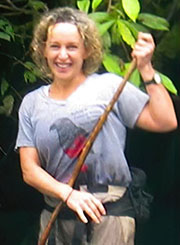 Debra D. Wright, PhD
1998 Ph.D. in Tropical Biology from the University of Miami; 1989 M.Sc. in Zoology from the University of Florida; 2008 Master of Accounting courses from Chatham University; 1986 B.Sc. in Zoology from the University of Florida.
Debra began her career trapping and radio-tracking opossums for four years in Florida and for a month in Venezuela. She met Andrew Mack on a 2-month tropical biology field course in Costa Rica which became a capacity building model for their life’s work in Papua New Guinea, where she spent most of her time from 1987-2012. With him she co-founded and built the Crater Mountain Biological Research Station in 1989 to make it easier for other scientists to explore the little known flora and fauna of PNG; over 150 scientific papers have been published from research conducted there. She lived at the station from 1989-1993 conducting her dissertation work on cassowaries, in addition to establishing long-term plant plots, trapping mammals, and mist-netting birds and bats. She has mentored PNG Honors students since 1994 and has run month-long remote field biology courses for PNG students from 1996-2012. She raised funding for, organized, and led five altitudinal bio-diversity surveys for mammals, birds, herps, and plants from 1996-1998, with full training for both a landowner and a PNG student/professional in each taxa. She took dozens of these landowners out to the National Herbarium in Lae and the National Museum in Port Moresby so they could see where the vouchers would be housed and know that generations to come would be able to see and experience them. With Andy she co-founded and ran the Wildlife Conservation Society’s PNG program from 1999 through 2007, with a major emphasis on capacity building for PNG biologists so that research and conservation could come from within the country, by its own citizens, in ways that would work culturally. They build a ‘campus’ in Goroka where they mentored dozens of PNG Honors students through 2-year research degrees and helped them obtain scholarships for Masters and PhDs in Australia, the UK, USA and New Zealand. They envisioned and built the program, raising almost all of the funds for it, including their own salaries. In 2007 WCS said they were not a university and abruptly said they were closing the program; Deb convinced them to allow two PNG nationals to take over as interim Co-Directors until remaining grant funds ran out. In 2008 she co-founded the Papua New Guinea Institute of Biological Research with those Co-Directors and other former students to continue the work as a fully PNG-led organization. She has raised over US$8 million in grant funds and has dozens of peer-reviewed scientific papers/book chapters. Debra is a co-founder of GC and PNGIBR.
Founding Board Member
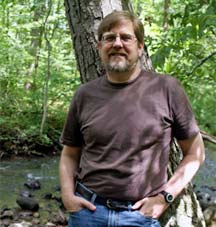 Andrew L. Mack, PhD
1995 Ph.D. in Tropical Biology from the University of Miami; 1985 B.Sc. in Biology from the University of Delaware.
Andrew has been involved in rainforest research and conservation since 1974 when he made an expedition to the summit of El Triunfo in Mexico. Since then he has worked in Mexico, Costa Rica, Ecuador, Guyana, Peru, Bolivia, Malaysia and Indonesia. His recent focus has been on Papua New Guinea where he spent most of his time from 1987 through 2007. He currently holds one of the few endowed conservation biologist positions in the United States, the William and Ingrid Rea Conservation Biologist at the Carnegie Museum of Natural History which is funded by the Heinz Endowments. He has been a Fulbright Scholar to PNG, a Visiting Fellow at Australian National University, and is a Research Associate at the University of Kansas. He has held senior positions at Conservation International and the Wildlife Conservation Society and was Collections Manager for Birds at the Academy of Natural Sciences. He was a co-founder of the Crater Mountain Biological Research Station in PNG. His research in PNG over twenty years has examined seed dispersal by cassowaries, seedling ecology, biogeography & phylogeography, ornithology, bioacoustics, hunting & wildlife consumption, and a wide range of topics with collaborators from eight countries. He has a species of frog and a canopy tree, both from New Guinea, named in his honor. He has over fifty scientific publications. He is most proud of the many UPNG students he helped to mentor through Biology Honors Degrees. Most of these have continued on to Masters Degrees at top universities and are now conservation professionals in Papua New Guinea. Andrew is a co-founder of GC and of PNGIBR.
Founding Board Member
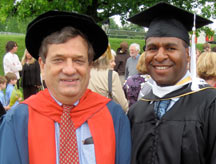 Patrick L. Osborne, PhD
1978 Ph.D. in freshwater biology from the University of East Anglia; 1974 M.Sc. in Tropical Resource Ecology from the University of Zimbabwe; 1972 B.Sc. (Honours) in Botany and Zoology from the University of London.
Patrick is the Executive Director of the Whitney R. Harris World Ecology Center at the University of Missouri-St. Louis. He has 35 years experience in tropical ecology research, education and environmental consultancy in Zimbabwe, Malawi, Papua New Guinea, Australia, Kenya and the Philippines. He taught ecology and botany at the University of Papua New Guinea for 10 years and was Head of the Biology Department there for three years. He has also taught ecology in Zimbabwe, Malawi and Australia and was Deputy Director of the Water Research Center at the University of Western Sydney in Australia. His research has focused on phytoplankton ecology and paleolimnology of tropical wetlands and lakes as a means to elucidating ecosystem function and change. He has published over 40 papers and co-authored Freshwater Plants of Papua New Guinea (University of Papua New Guinea Press) and is working on the second edition of his student text book: Tropical Ecosystems and Ecological Concepts (Cambridge University Press). He currently teaches courses in conservation biology, tropical biology and conservation, and ecology. The Harris Center supports graduate students in the Department of Biology’s Ecology, Evolution and Systematics program and recruits students from all over the world including (so far) five from Papua New Guinea. Patrick is a co-founder of GC.